
Portable and standby power
When normal mains ('Grid') electricity is unavailable, standby sources of power come into their own. These are usually limited in their ability to provide power compared to grid supplies, so as well as locating practical sources of power, it's worth considering low-consumption techniques such as those employed by people who live 'off-grid'.
This item is kept short, as there are numerous online resources for the off-grid community. In particular, the focus is on electricity as a source of power since with modern equipment it is a practical option much of the time unless there is neither sunshine nor the option of obtaining grid top-up power.
Low-energy appliances
Modern household devices like kettles, cookers, ovens and microwaves tend to assume that power is plentiful. Constrained supply (say a peak of around 1500 to 2000 watts) means choosing devices with a reduced peak demand and also adopting an approach of frugal consumption. Well worth considering, and often practical are:
- Travel kettles consuming 1kW maximum. Slightly slower to boil than typical household kettles but entirely practical
- Portable induction hobs. These are typically more efficient than either gas or traditional electric cooking as all the energy goes into the pan. They do require pans which work well on induction hobs, which means those with thick bases or made of iron. Heavy aluminium pans do work with some hobs, the urban myth that pans must be cast-iron is not strictly true.
- Electric pressure cookers. Check the peak consumption for compatibility but these are extremely frugal ways of cooking with electricity as they tend to be insulated and cook rapidly, reducing the overall power usage.
- Bread machines. Perhaps a slight luxury, but fresh bread is a morale boost in tough times. Usually having a peak demand well under 1kW, a budget of 0.5kWh for a loaf of bread should be expected.
- Microwave ovens with a modest peak demand can be a reasonably low-energy alternative to freshly cooking a meal. An oven rated for 800W will typically consume around 1.2kW when running, but if used for only 5 minutes will consume about 100Wh - much less than one might expect
Off-grid sources of energy
Petrol-driven generators are relatively low cost and widely available. Honda is the top-rated brand for petrol generators in the 1-2kW range, but whilst they have a very high reputation for quality and longevity, there are numerous competitors available at typically lower price points. If a generator is your only source of power then you are likely to want one with a peak output of around 2kW. More than this and the choice becomes more limited as these are 'serious' sources of power rather than for light/standby/camping use. There is a good choice of generators in the 1kW range but this tends drastically to limit the choice of appliances which can be run. There is also the option of dual-fuel generators (gas cylinders or petrol), these have the advantage that gas cylinders can be stored much longer than petrol which degrades quite quickly (6 months, say, unless specially treated).
Generators are noisy, smelly and need to be run in a ventilated but typically rain-free place. Under no circumstances should generators ever be run where the fumes can be inhaled as this can be fatal.
Advances in battery technology nowadays mean that rechargeable batteries are a realistic source of power, commonly recharged using solar, grid or generator sources. The typical combination is a substantial battery which can store 2kWh or more energy, a charger which can recharge the battery and an inverter which takes the battery energy and converts it to typical household appliance requirement of 230V. Those with a do-it-yourself approach can find plenty of advice online: youtube is replete with examples. Reliable sources as of early 2026 include Gary Does Solar and Will Prowse but there are numerous others.
Power banks like these are finding widespread use in places where grid supplies are intermittent, allowing the owner to charge them when power is available and then, when not, running a fridge and tv plus occasional other loads. Backed up by solar or a generator these are practical solutions to intermittent or unreliable power supply.
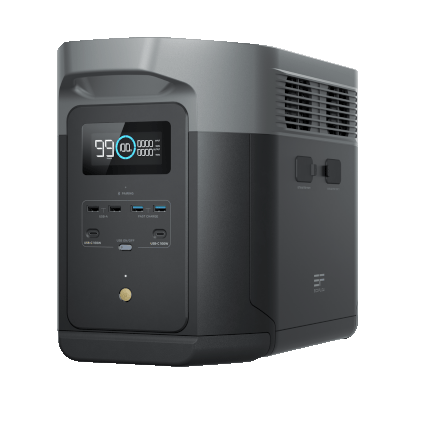
For those who are not on the tightest of budgets a number of manufacturers now sell complete portable 'power stations' which are also sometimes misleadingly called 'solar generators'. These package the key components into a single device typically incorporating one or more of:
- Ability to charge from solar panels
- Ability to charge from 12v car input
- Ability to charge from mains grid power
- 230V 'mains' output in the 2kW range
- 12V output
- USB outputs for charging
These power stations will typically contain a battery with 1-2kWh of capacity, providing enough power for, say, cooking and lighting for 1-2 days on a full charge, depending on your needs. The ability to recharge them from a variety of sources gives considerable flexibility. Many travellers/campers use them in conjunction with fixed or portable solar panels in the 100-400W range. In bright sunlight, just 200W of solar input can be enough to top up the battery in a few hours, giving the frugal user more or less complete independence from grid electricity.
It's also common to supplement this kind of battery storage with a generator or occasional grid top-ups. When solar power isn't adequate (say in the UK during the darker months), running a 2kW generator for a little over an hour will fill a 2kWh battery, reducing the times when the noise is produced and also, importantly, using much less fuel for the generator as it's much more efficient to run a generator briefly at close to maximum power than run it for hours at low power. Here is where the smaller generators come into their own, as even a 1kW generator is fine for charging a power bank (though it takes longer).
There are several well-respected manufacturers of power stations, including Jackery, Anker, Bluetti and Ecoflow. A typical example from Ecoflow is the Delta Max 2 which provides a peak output of 2kW and 2kWh of capacity - expandable with extra battery packs.
It's common on campsites to see fold-out solar panels capturing energy for these kinds of power stations which are in part replacing the gas or petrol stoves which were the previous go-to choices for cooking (though certainly not as cheap in terms of outlay).