Communications
What The Guide Says
You must be able to receive news and important information from government authorities
Disorientation due to lack of reliable information is a common complaint from people who have experienced emergencies[1].
Radio has been the primary form of emergency communication in the UK for the last century, but the UK government are now also using an emergency alert system to mobile phones. Pay attention if you receive one and follow any advice it contains.
Make sure you know how to tune your radio. Frequencies to know:
- BBC Radio 1 (97-99 FM)
- BBC Radio 2 (88-91 FM)
- BBC Radio 4 (92-95 FM
Good things to keep at home:
- Radio powered by batteries, solar panels or a handcrank (or all three)
- Extra batteries
- Important phone numbers written down on paper
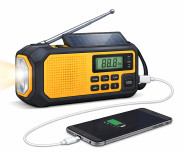 An emergency radio like this one is available
online for around £25. Practice tuning it
ahead of time so that you are ready to use it
when you may be feeling less clear-headed.
Be cautious of online sources which may be spreading misinformation with malicious intent, generated by AI or on websites which have not been updated. Also be aware that you may not be able to access the internet. The radio stations listed above are your best source of reliable, up to date information.
If you get poor reception where you live, try going higher up, say upstairs if possible, or local high ground. FM radio reception is better the more elevated you are (but stay safe)!
Naturally, you will want to be able to stay in contact with family and friends, but be aware that in certain situations, mobile phones and the internet may not work. This is why it is a good idea to bring up this topic ahead of time and let the people who care about you know your plans and preparations for an emergency if it hits.
Rationale, background and more
This guide references BBC radio 1, 2 and 4 as sources for reliable information - only R2 and R4 are engineered to stay 'on air' for the duration of expected emergencies[2]. Unless you live close to a main transmitter site you may normally use a relay site which will not be resilient so be prepared to retune your radio if necessary. DAB radio is not engineered for resilience.
Wind-up radios look promising but after experiencing the use of one you may strongly prefer batteries; a radio which does both and also can use solar gives you 'belt and braces'. Note also that most cars have a FM radio which will run from the vehicle battery; if you use this be cautious about running down the battery.
If mobile phones and internet have stopped working it will be almost impossible to communicate over any distance. This is a popular and enduring topic in the preparedness community. Unless you are prepared to become at least partially skilled in radio communications there are no simple answers to this other than relatively cheap and short-range 'PMR446'[3] walkie-talkies. PMR446 radios are widely used in schools, workplaces, by hikers and in similar pursuits so you may be familiar with them. They can cost as little as £20 for a pair. This site will eventually expand to say more on the topic of two-way radio in emergencies.